
Sonoma Valley, California: Present Day
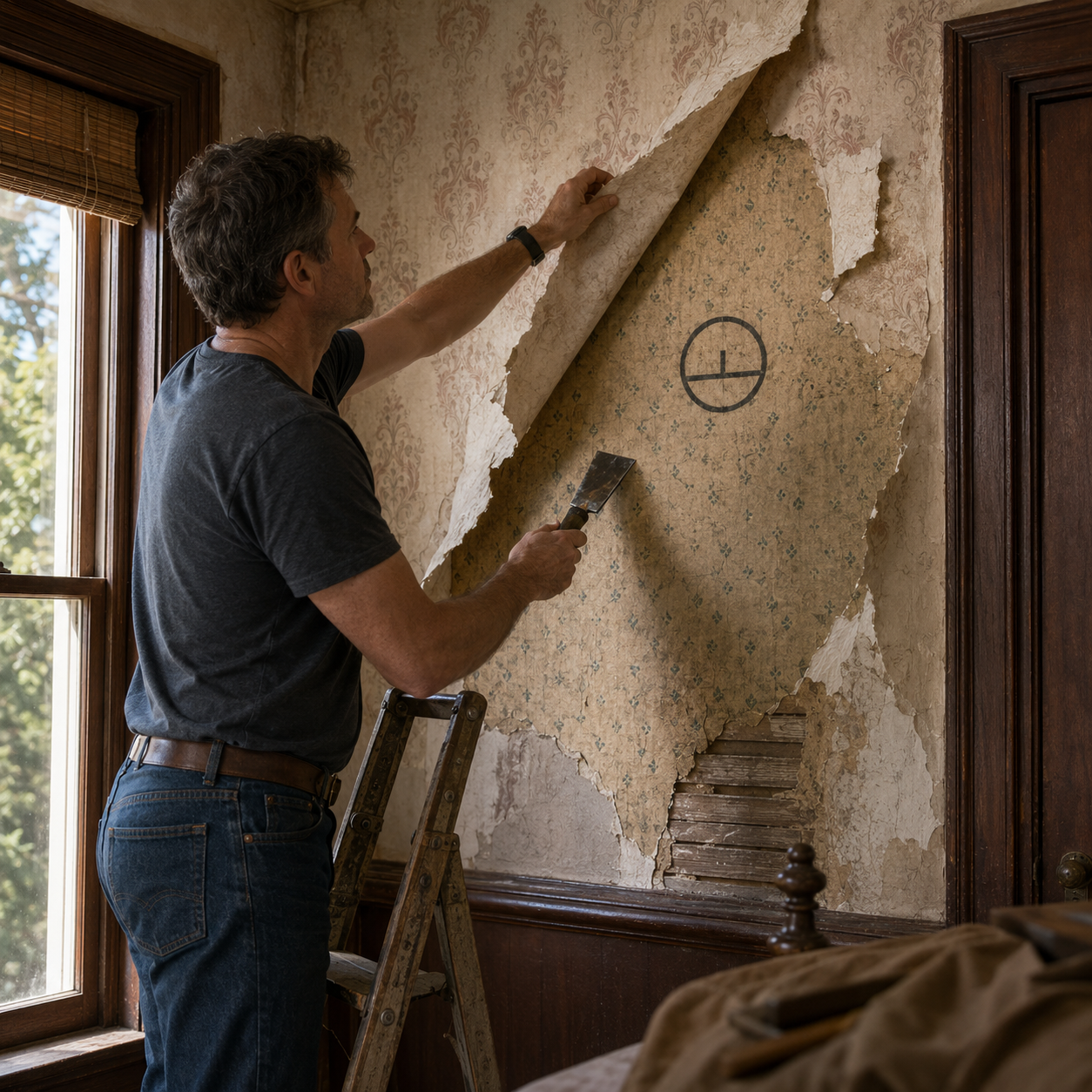
Anson could not really recall the first time he had seen the symbol. He had passed it so many times that he had come to regard it as background noise. It wasn’t particularly noteworthy, and no one else had ever mentioned it. So he assumed everybody deemed it just as unremarkable as he did … Until today. Today he was up on a ladder, stripping wallpaper from the back bedroom of his Sonoma Valley winery estate … But as often happens when you strip wallpaper, the excavation yielded an earlier wallpaper from a bygone era. The room had been papered over. This, in itself, was not remarkable. What was remarkable – very remarkable –
was that the earlier wallpaper bore an instance of the same symbol that was on the City Hall. Exactly the same symbol – in approximately the same dark color. Just one symbol, by itself, in either location, would not be news. But two of them, in different locations – well, that had to mean something, he thought … The symbol consisted of a circle bisected by a horizontal line. From the middle of the line another line rose up vertically to reach about half of the radius. That was it. He had originally thought the symbol on the keystone might have been some kind of stonecutter’s mark. But why had it persisted, even through cleaning? Perhaps, he once thought, it was just a freak accident of nature from when the stone was geologically formed – not a human artifact at all. But the same symbol on the wallpaper killed off that hypothesis in one fell swoop. Another, matching, freak accident of wallpaper formation? No. This had to have been placed here intentionally by a human. Which means the one on the keystone was also placed there by a human. Most likely, the same human. Someone was trying to send a message.
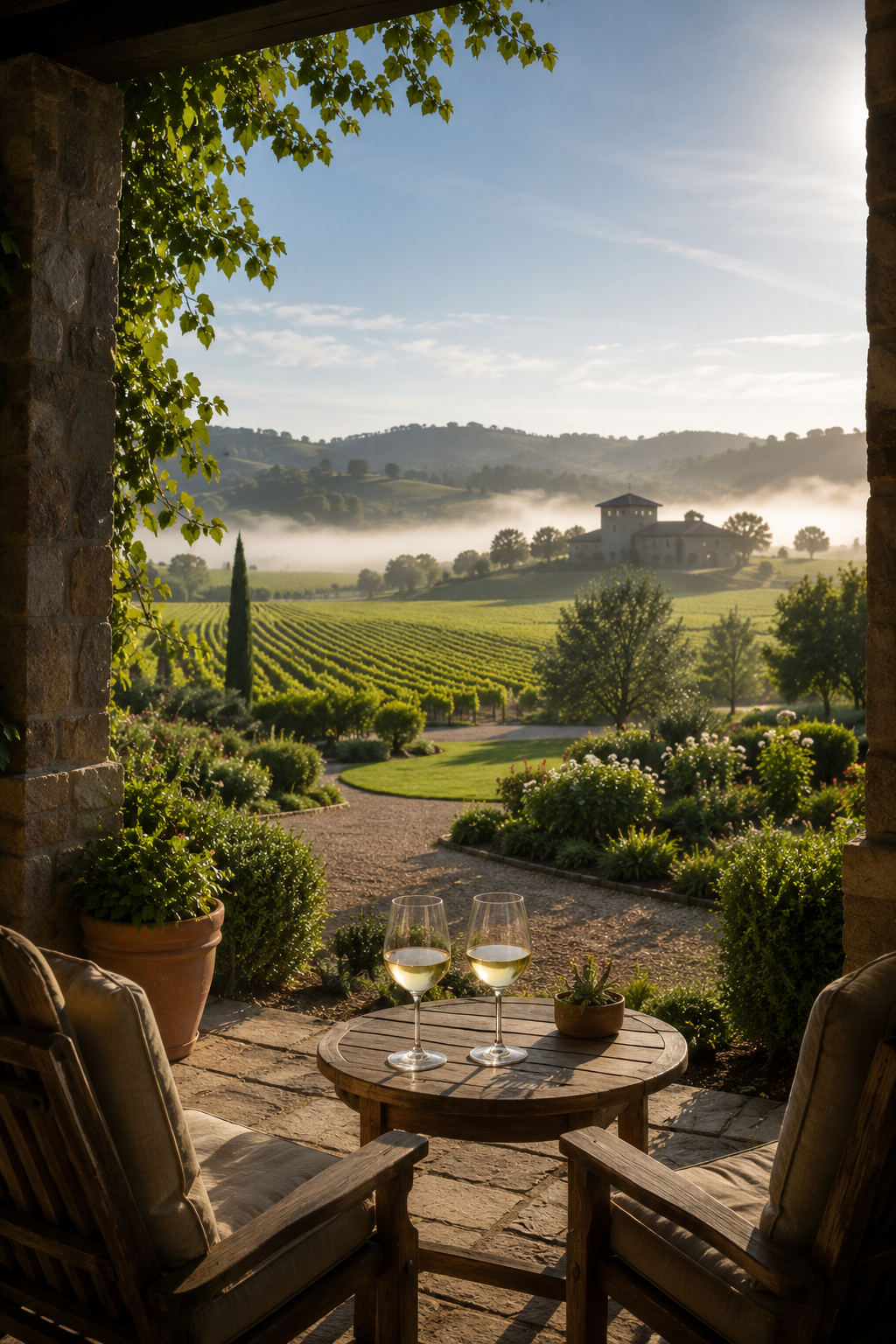
This is where you stop to take a breather. The current vintage is in the barrels, and your attention will soon turn to evaluative sampling of prior-year vintages still in the barrels to tune them on their way to eventual bottling. But you have earned the right to sit outside in front of the stone estate building for a spell, and enjoy the view. That’s what Anson and Mia were doing today – mostly nothing.
As they quietly sipped their new release of Chardonnay, and watched the rising sun burn off the valley fog, Mia’s thoughts turned once again to the symbols that only Anson could see …
“Have you thought any more about what to do about your strange powers of perception? Why you see the symbols and no one else does?”
“Yes, I have thought a little … but not so much about why only I see them, but what they mean. That’s the more intriguing question, don’t you think? Just grant for a moment that the symbols are where I say they are – or better yet, just pretend that you see them too. Why are they there? Why are they in those two locations? Who put them there? Who were they meant for?”
“That’s a lot of questions.”
“Well, let’s start with who they were meant for. The one on the wallpaper is as old as the wallpaper itself. So someone put it there a long time ago. Long before we bought the estate. So the writer would have had no idea who I was. I probably didn’t even exist yet. So they couldn’t have been messages for me. But if the symbols were meant for some contemporary of the writer, why place inscrutable symbols on the wall? Why not just relate the intended meaning to this person directly?”
“Maybe it had to be secret. Maybe they were afraid that someone else might find out.”
“Then why write it on the wall at all? Why not just tell this person in secret?”
Suddenly, Mia had an epiphany. “Anson! Maybe that’s the point! It was meant for someone who would come later – someone who would be the only person able to see the symbols. You!”
Oxford, England: Present Day
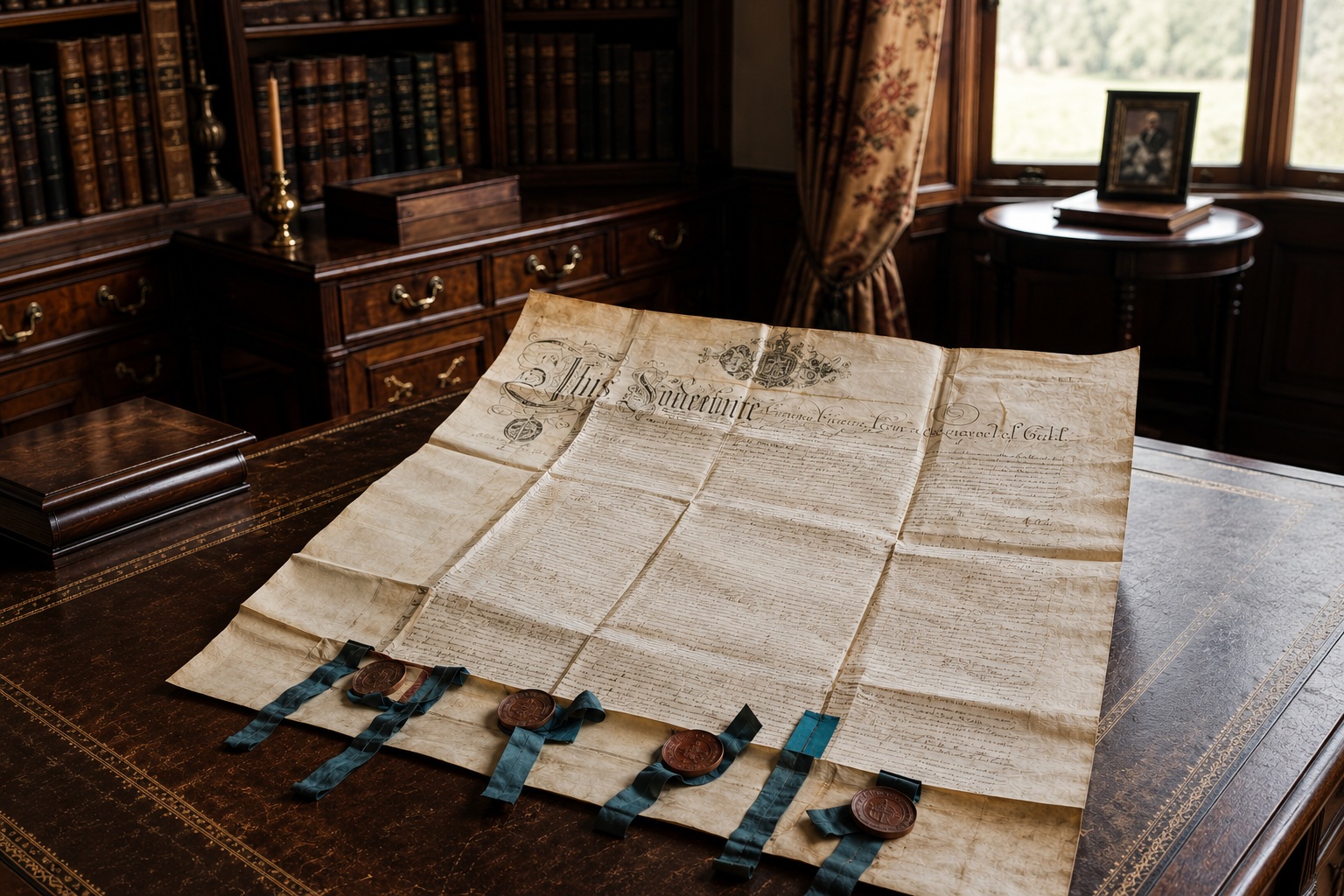
Even though she didn’t know what he was searching for, the archivist was fully invested now. “There might be more!” she offered. She carefully folded the parchment again, and was about to place it back on the pile and go for the next one when Anson caught a glimpse of the endorsement on the outside.
“Wait! Let me take a closer look at the outside.” Below the words
Marriage Settlement of
Henry Gladstone, Esq. and Miss Guasha Natakho
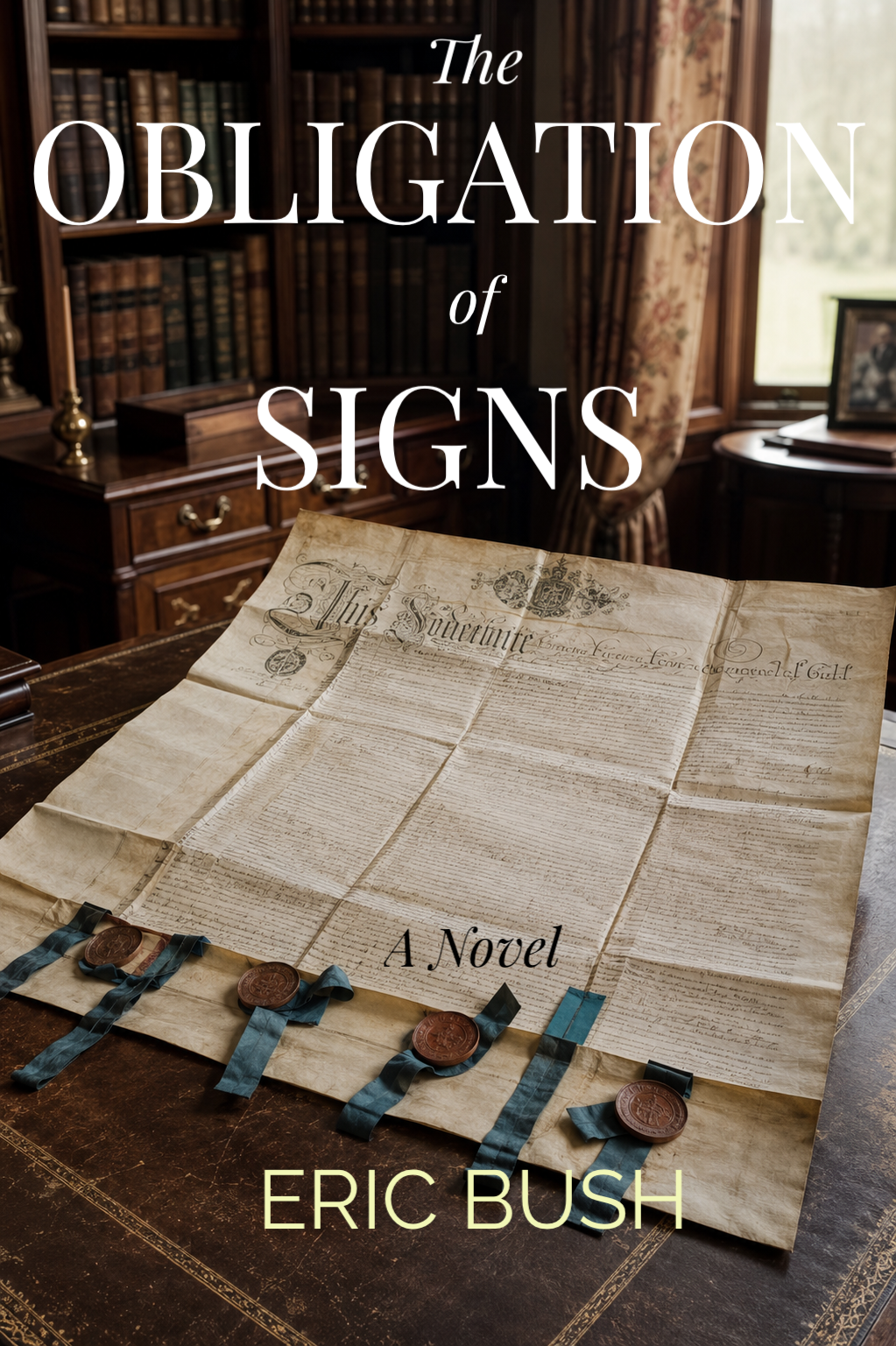
27 August 1850
he saw the symbol. “It’s here – the symbol,” he pointed (without touching).
Jacob knew better than to crowd in, given the archivist’s earlier admonition, but Liz suddenly moved to the scene as close as she politely could. She had been steeling herself for the possibility that the segment was going nowhere, when suddenly it was going somewhere. She was inclined to call ‘cut’, to reframe the moment of discovery, but thought better of it. She would let the discovery play out first, and see where it went. She could always reshoot later.
Anson pulled out his notebook and pen, and was about to copy what he saw, when the archivist stopped his hand. “No pens, please. I’ll get you a pencil.” She quickly did.
Anson had now developed a protocol, after his first two discoveries, of
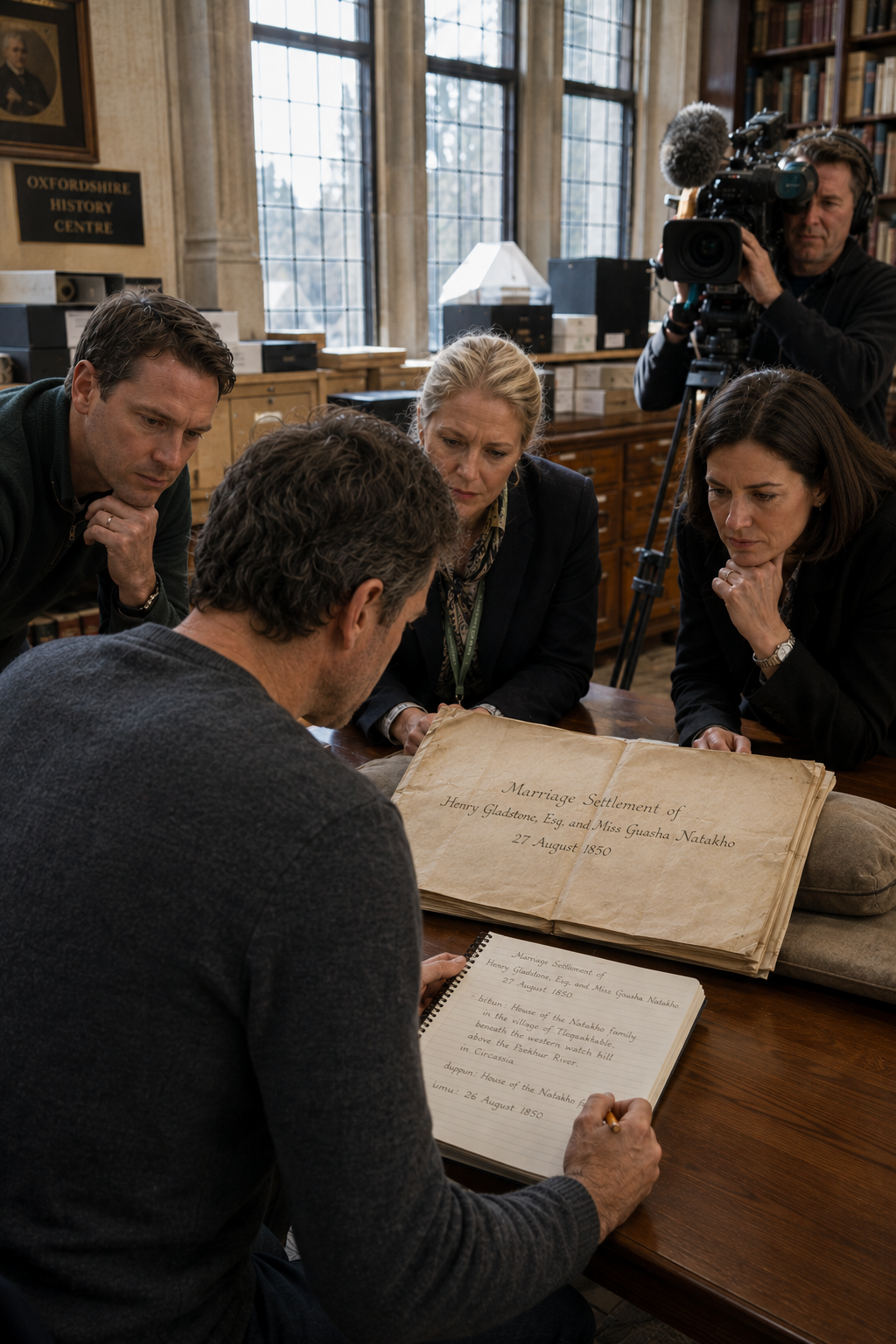
drawing the symbol to scale, and recording the words in the same relative positions that they appeared. Below his drawing of the symbol he wrote
bītum: House of the Natakho family in the village of Tlepsakhable, beneath the western watch hill above the Psekhur River, in Circassia
duppum: House of the Natakho family
ūmu: 26 August 1850
The group anxiously watched him writing, waiting for him to announce what he saw. He did, though he struggled with the pronunciation of some of the proper names. He recognized none of them.
“Circassia?” Liz mused, quizzically. “Isn’t that somewhere in the Caucasus?”
“Yes,” the archivist volunteered. “At least it was. North of Georgia, along the Black Sea, I believe. It was absorbed by the Russian Empire in the nineteenth century. It no longer exists as a country.”
Now Liz knew she had something of news value. She forgot all about the invisibility angle for a moment. “From a no-longer-existent Black Sea country to Oxford in the 1850s. That’s quite a revelation, Anson. Will you have to go there next?”
The Black Sea: 1835
The Turkish crewman, serving as lookout on the roof of the aft cabin, was just focusing his eye through his spyglass toward the western horizon, when he spotted something – the gleaming white topgallants of a square-rigger, peeking over the horizon, bearing east northeast in their direction.
“Sails!” he shouted out in Turkish. “Square-rigger off the starboard bow-quarter!”
The captain quickly focused his own spyglass in that direction. From his lower position, he could only see the topmost sails that the lookout had reported.
“Can you make her out?” he shouted in Turkish.
The lookout needed to wait a little longer for the hull to rise over the horizon. When it did, he could see a single white stripe running the length of the black hull, checkered by black squares. He yelled, “British frigate! Royal Navy colors!” He made a quick assessment of its silhouette, and estimated the gun ports by noting the density of the black squares, then yelled, “Looks like a 46-gun, 18-pounder!”
The captain suddenly had a decision to make. They could not engage a large British frigate with that much sail and firepower. His only hope was to divert to the eastern coast, looking for an inlet too shallow for the larger, deep-drafted frigate to navigate.
“Fall off! Dead down wind!” he yelled to the helmsman. “Make for the coast!”
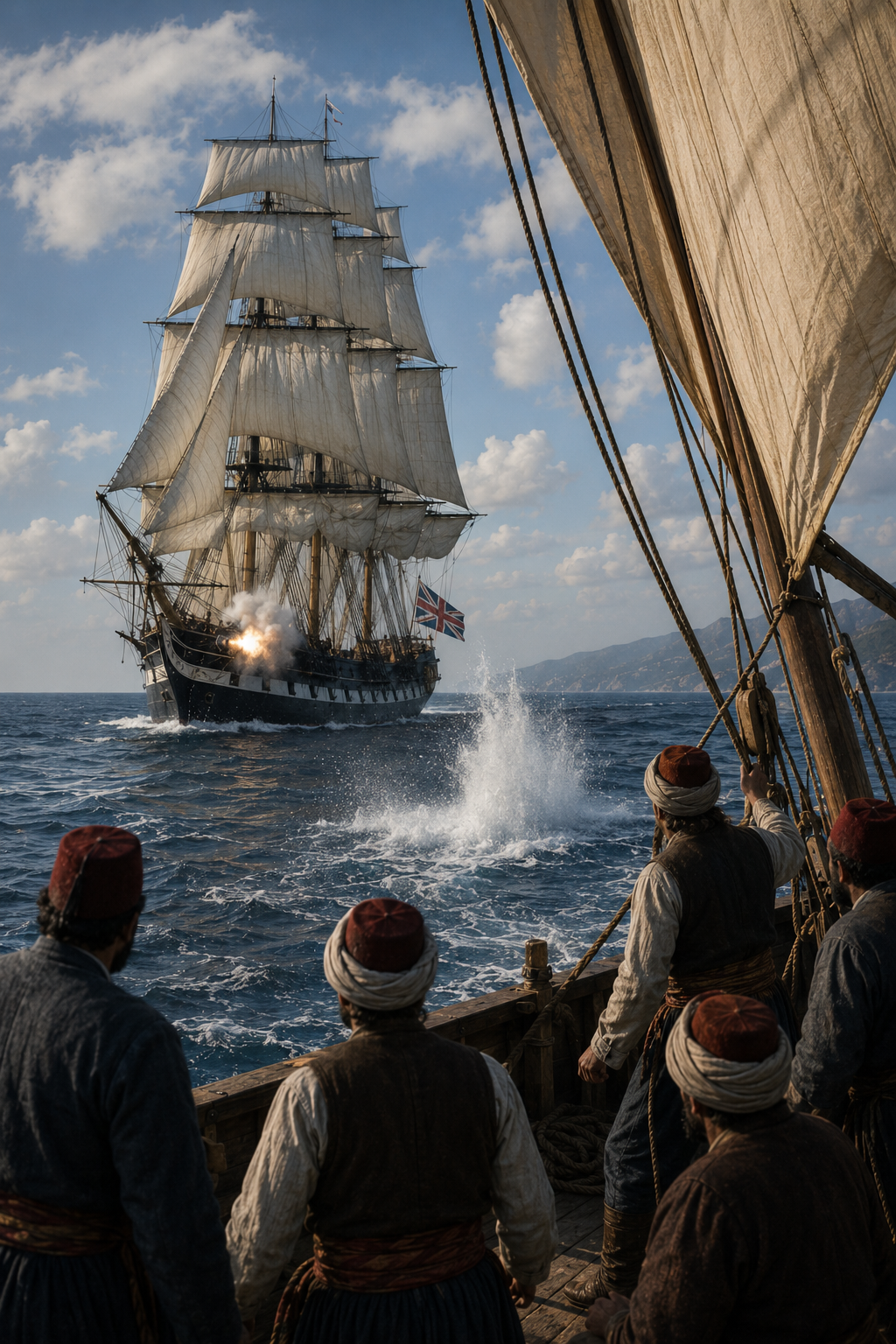
The British captain knew, at this point, that the Turkish captain had made a fatal tactical error in his attempt to run for the coast. His saic was built for speed on a beam reach. It was less efficient, and thus slower, on a dead run. A square-rigged frigate was built for speed downwind. It could spread massive amounts of stacked rectangular sails that the wind would push directly. The race would not even be close.
As the British frigate rapidly closed the distance, the Turkish captain could see the endgame. He would never reach the coast. When the frigate had closed within a mile or two, the British captain could now confirm his suspicion of a slaver. A legitimate saic trader, carrying a legal cargo like timber or stone, would sit deep and slow in the water. The Turkish ship was riding high in the water, bouncing nimbly over the swells – proving its hull was mostly empty of heavy ballast, leaving plenty of air space in the hold for human cargo.
The final act of this endgame was the “shot over the bow.” This was a ritualized warning shot. It meant “Stop!” The Turks could first see a silent flash of orange fire from the British bow. After a few seconds, the speed of sound caught up with the speed of light, resulting in a massive boom, accompanied by a screaming 32-pound iron ball cutting through the air and smashing into the sea fifty yards or so ahead of the Turkish bow, throwing up a huge white spray of water.
“They mean to board us,” the Turkish captain said. “Strike the colors and heave to!”
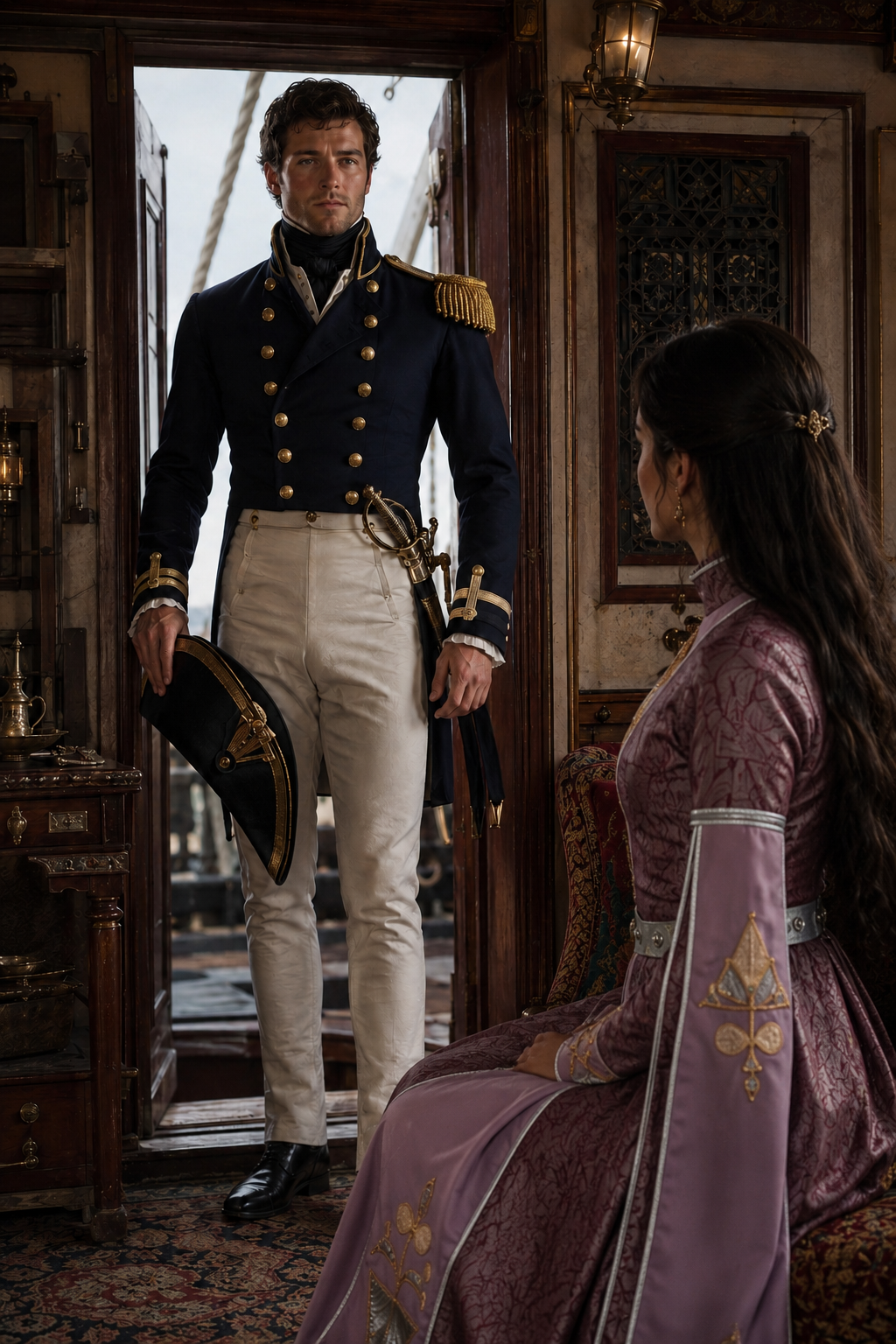
Guasha’s assessment of the situation soon changed when she heard a man speaking the newer language questioning one of her captors on the other side of the door. The tone of the questioning soon shifted to barked orders. She heard the key in the lock, then the door was opened. It was not a sight she was expecting. She recognized the Ottoman captain, but the other man was neatly dressed in a crisp, colorful, military uniform of dark blue and white, two rows of shiny brass buttons, and copious gold trim. With the strangest of hats. She knew uniforms, but this was different. No Hussar braids or papakha. But he was clearly a warrior of some sort because he had a sword strapped to his side.
He was a clean-shaven, younger man. His remarkable hat resembled a horizontal half-moon, pulled down on his head so that the two corners of the semi-circle extended out over his shoulders, making the silhouette of his head appear as wide as his shoulders. His dark blue top coat was tightly tailored at the torso and waist, then stopped abruptly at the waist in the front, but split into two long tails in the back. She recognized, and appreciated, this tailoring. It was not unlike her own, minus the skirts. But from there down, it couldn’t be more different. He wore tight-fitting, tailored, immaculately white trousers right down to his polished black shoes. Not boots – shoes! She had never seen anything like this on a warrior, let alone a man. It was hard for her to imagine him as a warrior with such fine, spotless, clean clothing. But then, of course, she had never seen a military sailor before. Sea battles were probably cleaner, she reasoned. No mud, no horses, and plenty of water.
The high collar on his coat also resembled hers, though his neck was wrapped in black cloth. And there was gold embroidery everywhere – not unlike her silver embroidery. He had a single, gold epaulette on his left shoulder. She had seen these before on Cossack officers, but they usually came in pairs, she thought.
But it was not the strange uniform that impressed her most, it was the warrior’s demeanor. He immediately took off his hat in her presence, as a show of respect. This was so unlike the Cossacks, with their false, grinning smiles, or the Ottoman captain with his solicitous, scheming smile. This man did not smile at all, but showed restrained deference. It reminded her of Adyghe Khabze. And here she was, sprawled out awkwardly on the floor in front of him. She immediately stood up and assumed her proper Circassian posture – not unlike his – before he had a chance to extend his hand.
Oxford, England: 1849
Benedict turned to Henry in surprise. “Beethoven? She plays Beethoven?”
“Yes. Are you familiar with the C# minor Sonata?”
“No, I don’t believe so.”
“Perhaps you know it by its informal name. It’s often called the ‘Moonlight Sonata.’”
“Ah, the Moonlight Sonata! Yes, I know that one. It sounds like moonlight over the water. Very appropriate for a woman. I thought for a moment, dear fellow, that she was going to try to play one of those big, powerful ones that are quintessentially Beethoven – you know, like the piano concertos.” …
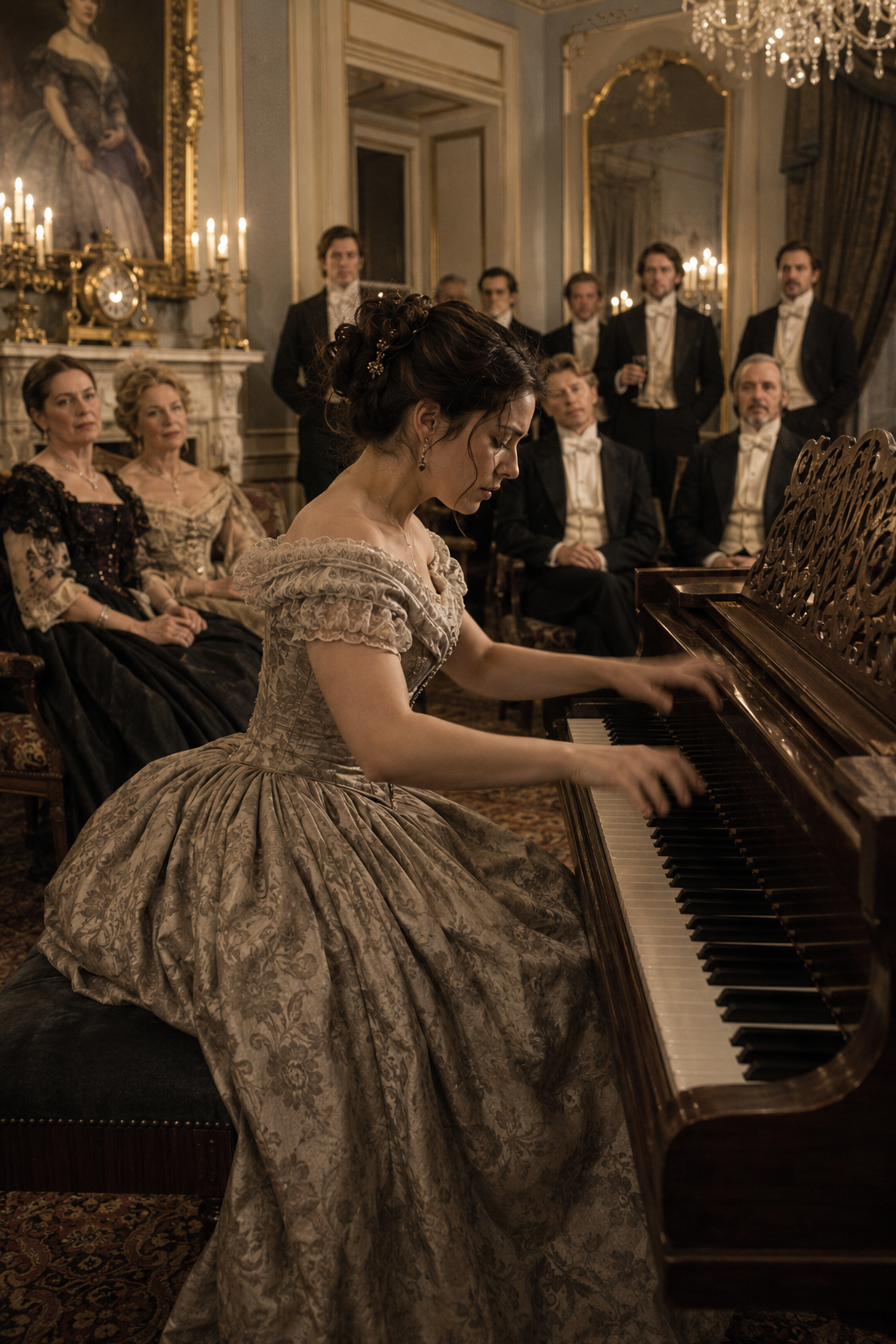
With that, the guests all moved to the drawing room to listen to Guasha’s performance. Most people only know the first movement of the C# minor Sonata, because it’s the one that sounds like moonlight – hence the name. The second movement is a little more upbeat, but it is still relatively light and playful. But the third movement! This is usually where Beethoven releases the storms. But this third movement is perhaps the most demanding piano piece in his entire repertoire. He is not subtle. It begins immediately with a furious ascending arpeggio in both hands that crests and repeats, again and again. There is no respite. It just keeps furiously raging, right to the end.
Henry watched the Southcotts’ tranquil smiles as Guasha moved laconically through the eponymous moonlight. When she finished the movement, she paused without looking up, as was traditional. Benedict was about to applaud when his neighbor stayed his hand. A common mistake among unseasoned concert-goers who don’t know the etiquette of waiting for an entire multi-movement piece to finish before clapping.
The second movement was also to the Southcotts’ liking. A little more spirited, but dance-like. Still something they could relate to as in the domain of women.
But when Guasha abruptly opened the third movement, rhythmically hammering the keys in the first great ascending arpeggio, they were stunned. Not so much because a woman could do this, but because anyone could. It was both the erupting harmonics of the sound, and the vision of those fingers flying over the keys – in perfect control – that produced an experience that they had probably never witnessed before in a chamber setting.
Henry alternated his attention between Guasha and the Southcotts. He didn’t want to miss a moment of her performance, but couldn’t help occasionally watching their reactions. When Guasha finished, and let the sound of the last chord dissipate before lifting her hands off the keys, the audience immediately stood up to applaud, and even to cheer in as boisterous a tone as their Victorian reserve would allow. The Southcotts stood and applauded as well, visibly stunned by the performance.
Work in Progress
This novel is a work in progress, anticipated to come out in 2027. It is likely to be finished well before then, but remain unpublished. In Dickens’ time, it was common for novels to be serialized in magazines, as the chapters were written, before finally coming out as a complete book. You can approximate that experience here, if you are interested.